
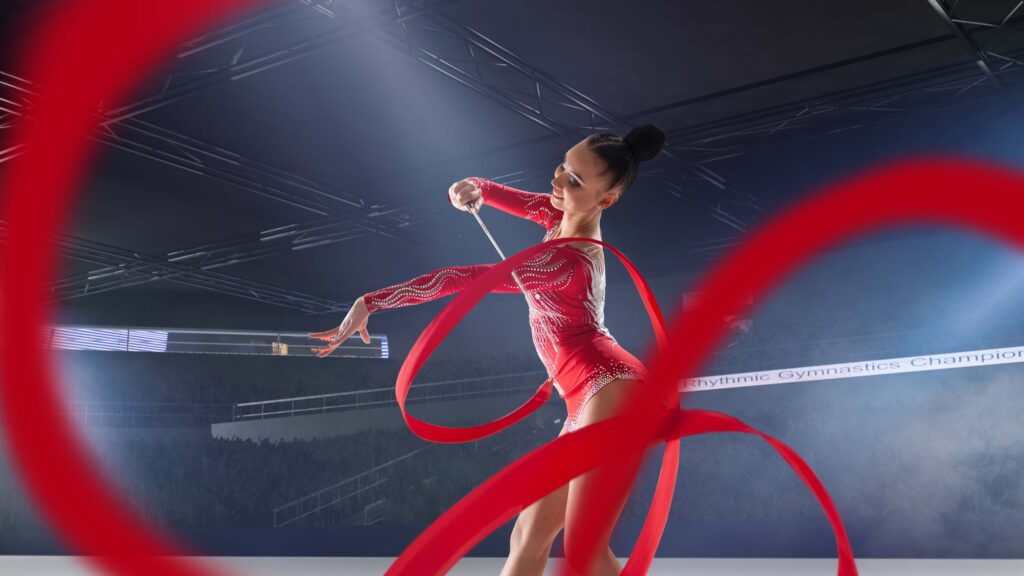
Rhythmic-based gymnastics combines sport and art into one smooth performance. It mixes flowing movements with strength and balance. Each routine joins music, movement, and control to create something elegant and exact. Gymnasts leap, stretch, and twirl while guiding a ribbon, ball, hoop, rope, or club. They must twist, roll, flick, and toss with full-body awareness. Unlike other gymnastics, this one demands dancers to handle objects while dancing across the floor.
They do not vault or climb. Instead, they whirl with rhythm, keeping both body and tool in steady motion. The performance must connect the mind, muscles, and music without losing form.
How It All Began
Long ago, teachers in Europe explored new ways to train the body, creating programmes that shaped movement with care. In the 1800s, coaches in Germany and Sweden began combining fitness with expressive motion. Soon after, dancers in Russia and France added music and simple apparatus, planting the early roots of artistic gymnastics. These routines began to flow with elegance, with movements becoming smoother and more graceful.
By the 1940s, rhythmic gymnastics had taken its own distinct form. Coaches in the Soviet Union developed the sport further, structuring training and turning it into a highly skilled discipline. Over time, it spread across countries, with teachers refining routines and students training with increasing dedication. Today, rhythmic gymnastics is celebrated worldwide for its blend of strength, grace, and artistry.
Becoming a Real Sport
Artistic gymnastics needed rules and standards to become a sport. People gathered to decide how to score the movements and what made a routine excellent.
The first World Championship took place in 1963 in Budapest. It helped shape rhythmic gymnastics into a respected sport. By 1984, it reached the Olympic stage. This brought it into global focus. Women began performing solo routines with a single tool, matching movement to music.
Soon, group routines entered the stage. Teams of five performed together, tossing and catching tools mid-air. They had to march in perfect rhythm, keep every pass exact, and finish every pose with clarity. These group events pushed the sport even further.
Why Rhythmic Gymnastics Is Different
Rhythmic-based gymnastics stands apart from other forms of gymnastics. It does not include beams or vaults. It uses hand-held tools and a dance-filled floor routine. The goal is not only strength but also grace, flow, and timing.
Every turn and step must match the music. Each leap and twist must stay clean and polished. Tools must move with purpose. Ribbons must ripple, and hoops must circle smoothly. Balls must bounce with control.
This sport demands discipline. The gymnast must remember steps, follow the rhythm, and stay focused while using both body and object. Precision and poise matter, so each move links to the next without pause.
Dance at the Core
Ballet provides the foundation for rhythmic gymnastics. It teaches how to stand tall, stretch fully, and maintain strong posture. Dancers learn to control each movement with precision and focus.
Most rhythmic gymnastics athletes begin with ballet, learning basic steps that help them stand firmly, turn cleanly, and move with smooth, elegant lines. Ballet also enhances balance, strength, and overall control.
Many training programmes combine ballet with body conditioning. Coaches guide gymnasts to stretch correctly and move with skill. Lessons gradually become more challenging, but students always train with care. This combination of ballet and conditioning develops stronger, more confident rhythmic gymnastics performers.
How the Sport Evolved Over Time
Gymnastics with apparatus has changed over many years. At first, the routines were simple and gentle. Tools barely left the hands, and movements stayed close to the ground.
Then, the coaches raised the standard. They added more leaps, spins, and tosses. Gymnasts started to flip, stretch, and send tools flying across the room. The routines are filled with energy and complexity.
Scoring also changed. Judges began to score for risk, flexibility, and shape. Routines became more detailed. They had to cover more space. Each part had to show skill and rhythm. Countries added their own styles. Some chose smooth, graceful movements, while others focused on speed and power. But all had to follow clear rules and perform with accuracy.
What Makes It Special
Ballet forms the foundation for rhythmic gymnastics, teaching athletes to stand tall, stretch fully, and maintain strong posture. Dancers learn to control every movement with precision and focus.
Most rhythmic gymnastics performers start with ballet, practising basic steps that help them stand firmly, turn smoothly, and move with elegant lines. Ballet also improves balance, strength, and overall body control.
Many training programmes combine ballet with body conditioning, guiding gymnasts to stretch correctly, strengthen their bodies, and move with precision. Lessons become progressively more challenging, helping students develop the balance, control, and confidence needed for rhythmic gymnastics.
Conclusion
Artistic gymnastics connects strength with rhythm and turns movement into an art. It began with simple ideas and evolved into a sport that demands skill and structure. Today, it continues to shape students in powerful ways. With each step and motion, this sport proves that dance and discipline can work together. It improves posture, grows confidence, and guides students to move with style and purpose. Gymnastics with apparatus teaches the value of focus, balance, and elegance.
From solo routines to group performances, this sport forms a complete training journey. It teaches students how to move, think, and grow, all while staying in rhythm.